
Events
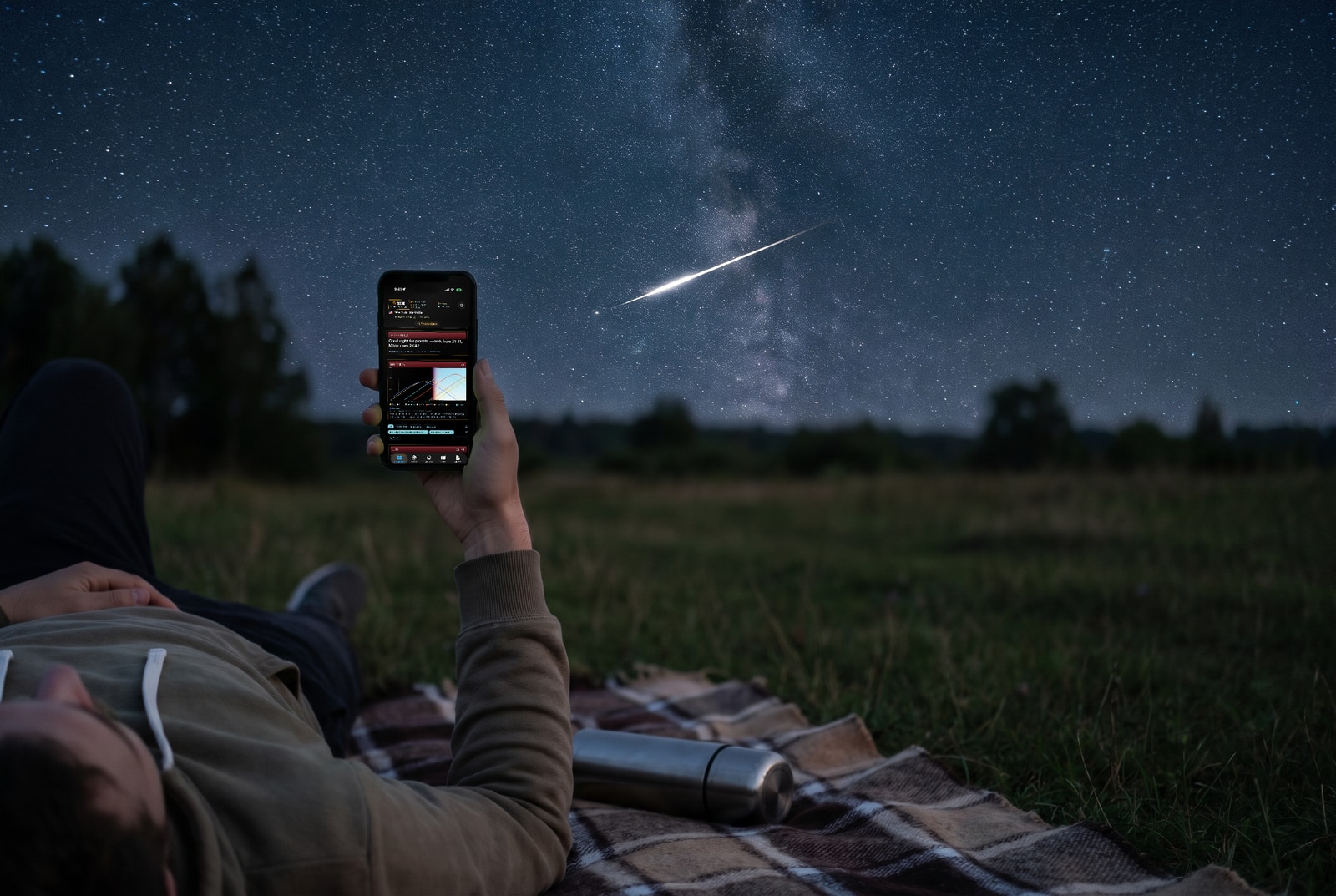
Celestial events and meteor showers — know ahead of time
Apphemeride searches for thirty types of celestial events and tells you when and where to look, and what equipment can help you observe them.

- When is the next full moon?
- When does Jupiter reach opposition?
- How many meteors might I see tonight?
- When will the Moon occult a bright star?
Thirty types of events
Lunar phases, eclipses, solstices and equinoxes, perihelion and aphelion, lunar perigee and apogee, oppositions, conjunctions, elongations, quadratures, retrograde motion, lunar occultations, planetary transits and meteor-shower peaks.
Each event explained
When it happens, where to look, which equipment you need and why it is worth observing, with a miniature sky map and time control.
Meteor rates for your night
For twelve meteor showers, the app calculates an expected hourly rate for your observing night from the activity profile and the IMO formula.
Custom scans and reminders
Create scans that search for close groups of bright objects, and set a reminder for the event itself or up to a week beforehand.
| Preview | one week to two years |
|---|---|
| Reminders | at the event, one hour, twelve hours, one day or one week before |
| Meteor showers | twelve |
| Profiles | naked eye, binoculars, telescope, custom |
Events, custom scans and reminders are part of the full version.
Frequently asked questions
Which meteor showers are included?
Quadrantids, Lyrids, Eta Aquariids, Southern Delta Aquariids, Alpha Capricornids, Perseids, Orionids, Southern and Northern Taurids, Leonids, Geminids and Ursids.
What is a custom scan?
A rule that searches the sky for close groups of bright objects, using your chosen magnitude limit, separation, object count and darkness threshold.
Will I get a notification?
Yes, a local notification on your iPhone, without an account.
Learn more in the guides
- Solstices and equinoxes: the seasons explained
- Full moon names and their cultural origins
- Lunar occultations: when the Moon hides a star
- Opposition, conjunction and quadrature explained
- Greatest elongation of Mercury and Venus explained
- Retrograde motion: why planets seem to turn back
- Meteor showers: radiants, ZHR and observed rates
Download Apphemeride
Free to download. The Sun and Moon are always free. Unlock the remaining features with the full version: a one-time purchase after a three-day trial, with no subscription.