
Eclipses
Calculate solar and lunar eclipses
Apphemeride calculates eclipses using Besselian elements, globally on the world map and locally for your location, with second-by-second simulations.
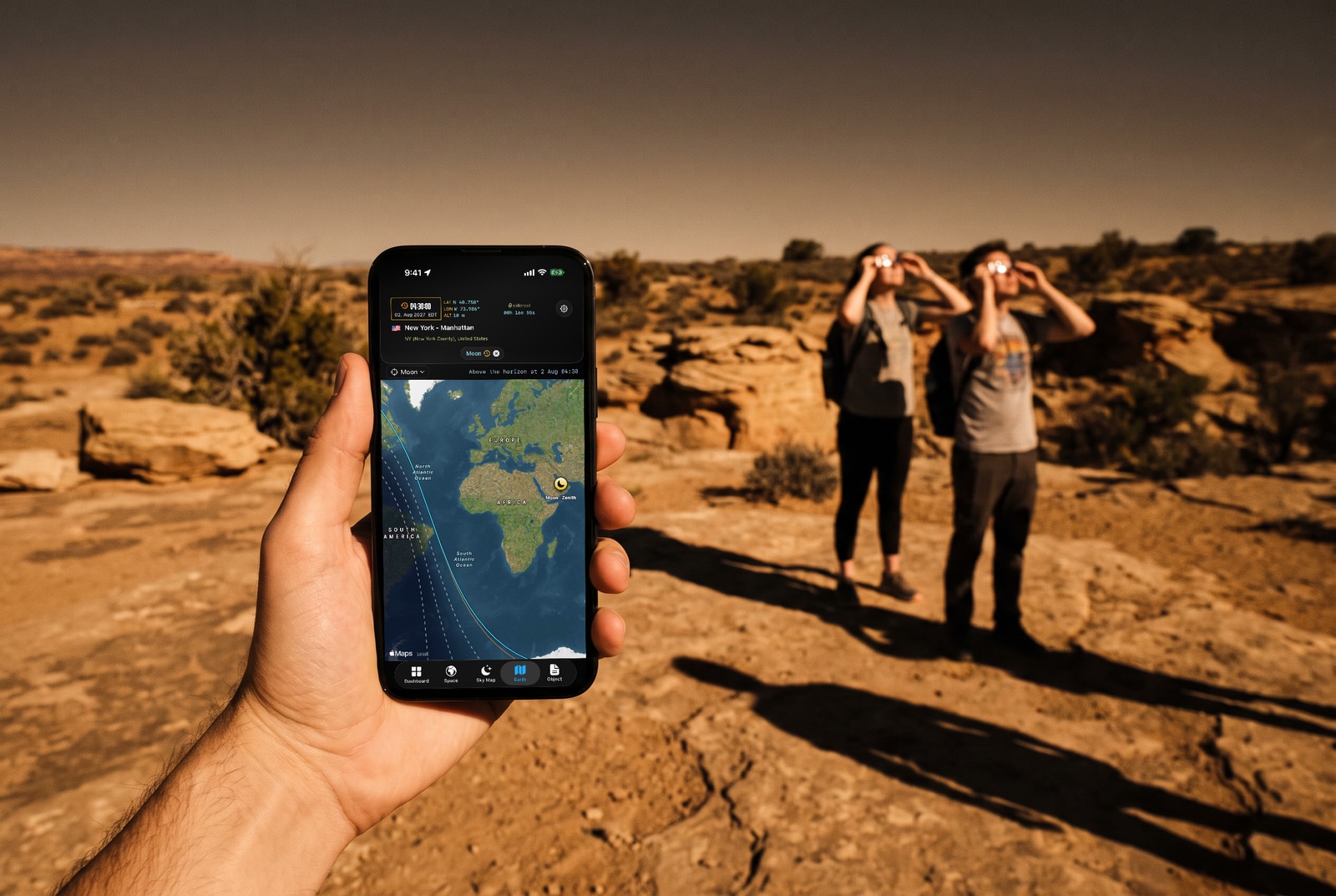
- When is the next eclipse, and can I see it from here?
- When does it begin and end?
- How much of the Sun is covered?
- Will it be total or annular?
The global picture
Find the start, maximum, end, type and magnitude of an eclipse, and follow the Moon’s shadow path on the Earth map, complete with a central line and time markers.
At your location
See contact times C1 to C4, the local maximum and duration, including whether an eclipse is already in progress at sunrise or continues beyond sunset.
Simulate the event
Play the eclipse second by second, in real time or accelerated, with obscuration and position angle.
Lunar eclipses and planetary transits
Explore contacts P1, U1–U4 and P4 with umbral and penumbral magnitudes, plus Mercury and Venus transits with contact times determined to better than one second.
| Solar contacts | C1–C4 |
|---|---|
| Lunar contacts | P1, U1–U4, P4 |
| Playback | real time, 30×, 1 min/s, 2 min/s |
| Methods | Besselian elements, ΔT |
Eclipse data in the Sun and Moon cards are free to view. Simulations and eclipse paths are part of the full version.
Frequently asked questions
How can I tell whether an eclipse is visible from my location?
The local view calculates contact times and tells you whether, and for how long, the eclipse can be seen from your selected location.
What do C1 to C4 mean?
First contact, the beginning and end of totality or annularity, and last contact. Partial eclipses do not have a total or annular phase.
Can I plan for an eclipse somewhere else?
Yes, using location selection in the full version.
Download Apphemeride
Free to download. The Sun and Moon are always free. Unlock the remaining features with the full version: a one-time purchase after a three-day trial, with no subscription.