
Object pages
The data behind the Sun, Moon, planets and stars
Each object page is a small observatory: times, directions, coordinates, distances and physical data, arranged in cards with 3D views and charts showing changes over time.
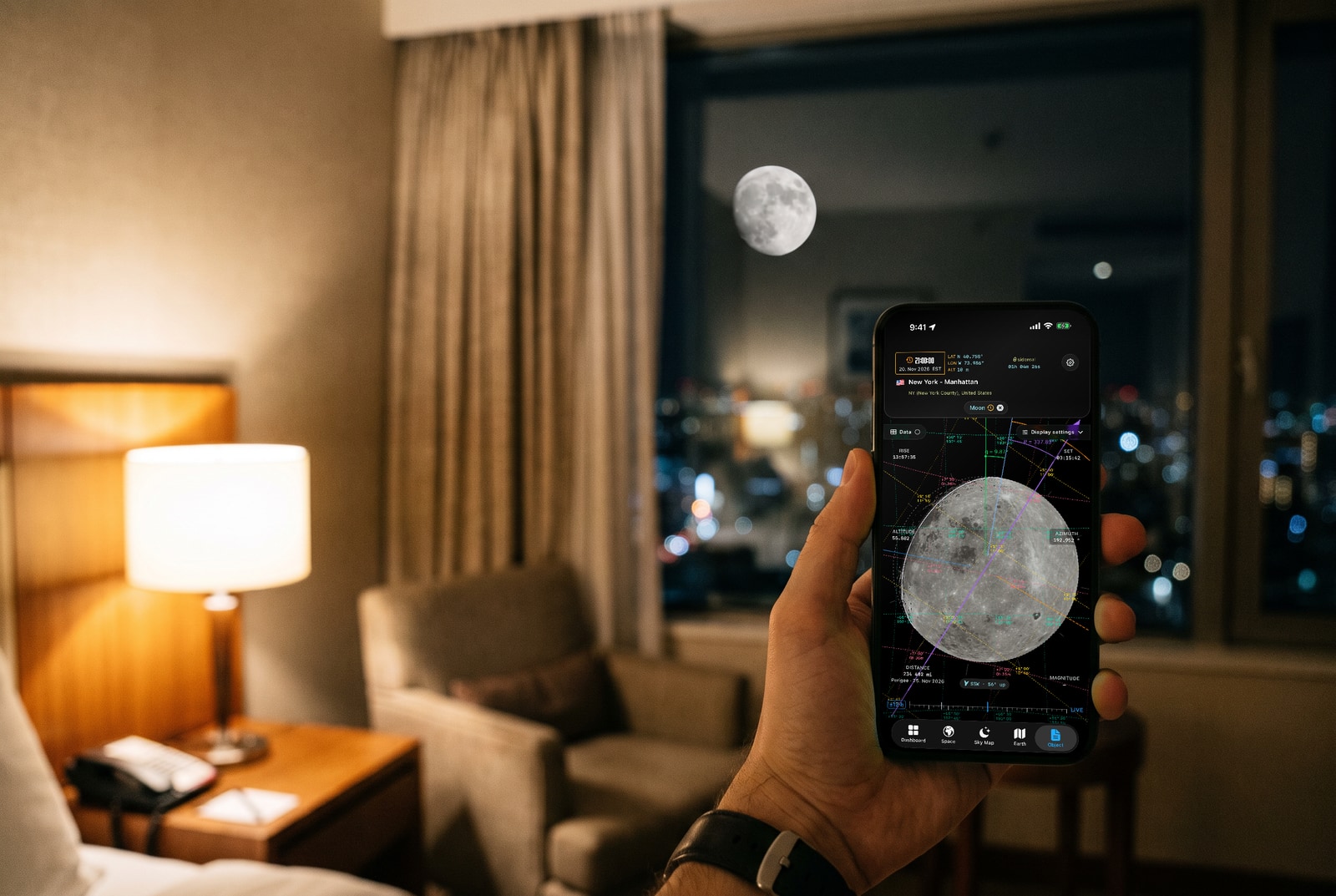

- When and where will the Moon rise?
- How far away is Mars?
- How tilted are Saturn’s rings?
- How bright and how distant is a star?
Rise, transit and set
Times and directions, refined iteratively to the second. The horizon chart shows altitude through the day, while a polar clock traces the path across the sky.
Coordinates and their corrections
Equatorial and ecliptic coordinates, J2000 and JNow, with nutation, aberration, precession and refraction, plus a matrix showing differences between epochs. The available coordinate cards depend on the object; star pages show coordinates for the date rather than a J2000 comparison.
The Sun and Moon in detail
Twilight, golden hour, blue hour, the equation of time, the analemma and seasons for the Sun; phase, lunar age, libration, supermoons and micromoons for the Moon.
Planets and their moons
Elongation, phase, brightness, orbital data and perturbations, together with the Galilean moons, eight Saturnian moons and ring geometry.
Star profiles
Brightness, colour indices, parallax, proper motion, radial velocity, spectral class and galactic coordinates.
| Around 550 calculated values | |
| Ten distance units | |
| Calculation methods | Meeus, VSOP87, ELP2000-82 |
|---|---|
The standard Sun and Moon data cards are free, from rise and set through coordinates and twilight to lunar phases and libration. Live sunspot data require the full version and an internet connection. Planets, stars, additional information tiles and 3D overlays are also part of the full version.
Frequently asked questions
What is the difference between J2000 and JNow?
J2000 uses a reference frame tied to Earth’s axis and the equinox at 1 January 2000; JNow refers to the date being displayed. Precession and nutation affect the relationship between the frames. The app shows the relevant coordinate representations for the selected object.
How accurate are rise times?
The app iteratively refines rise and set times, accounting for refraction and, if entered, observer elevation.
Is there a 3D view?
Yes, for the Moon and every planet.
Learn more in the guides
- Sunrise and sunset explained
- Golden hour and blue hour explained
- The Sun’s position: azimuth and altitude
- Day length: why daylight changes through the year
- Equation of time and apparent solar time explained
- The analemma: why the Sun traces a figure of eight
- Sunspots and the solar cycle explained
- Moonrise and moonset: why the times change
- Moon phases: from new moon to full moon
- Supermoons and micromoons: size and distance
- Lunar libration: the Moon’s apparent rocking
- Earthshine: the glow on the Moon’s dark side
- Saturn’s rings: tilt, opening and visibility
- Jupiter’s Galilean moons: positions and events
- Celestial coordinates: three systems explained
- Right ascension and declination explained
- J2000, JNow, precession and nutation explained
Download Apphemeride
Free to download. The Sun and Moon are always free. Unlock the remaining features with the full version: a one-time purchase after a three-day trial, with no subscription.